1 May 2026 : THE WORD OF CAMEROON HUMAN RIGHTS COMMISSION
Theme : _Social Dialogue and Decent Work : Factor of Peace, National Cohesion and Economic Development of the Company_
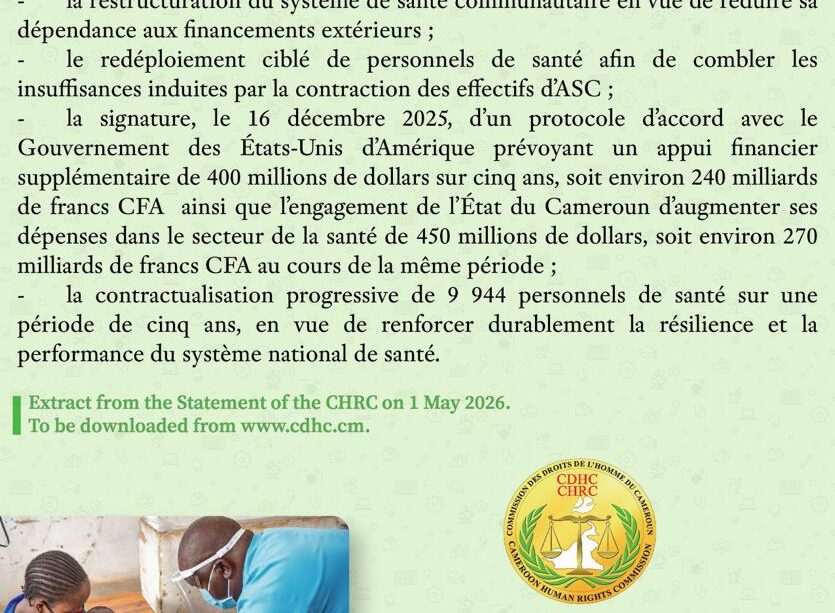
The Commission welcomes the theme selected by the Ministry of Labour and Social Security (MINTSS) for the 2026 International Labour Day, namely Social Dialogue and Decent Work : Factors of Peace, National Cohesion, and Economic Development of the Company, a theme consistent with the orientations promoted by the International Labour Organization (ILO), particularly through the promotion of decent work as an essential condition for social justice, institutional stability and inclusive growth and underscores the strategic importance of structured and sustained social dialogue between employers, workers and public authorities as a tool for conflict prevention, consolidation of national cohesion and strengthening of enterprise performance and competitiveness within a perspective of sustainable and balanced economic development.
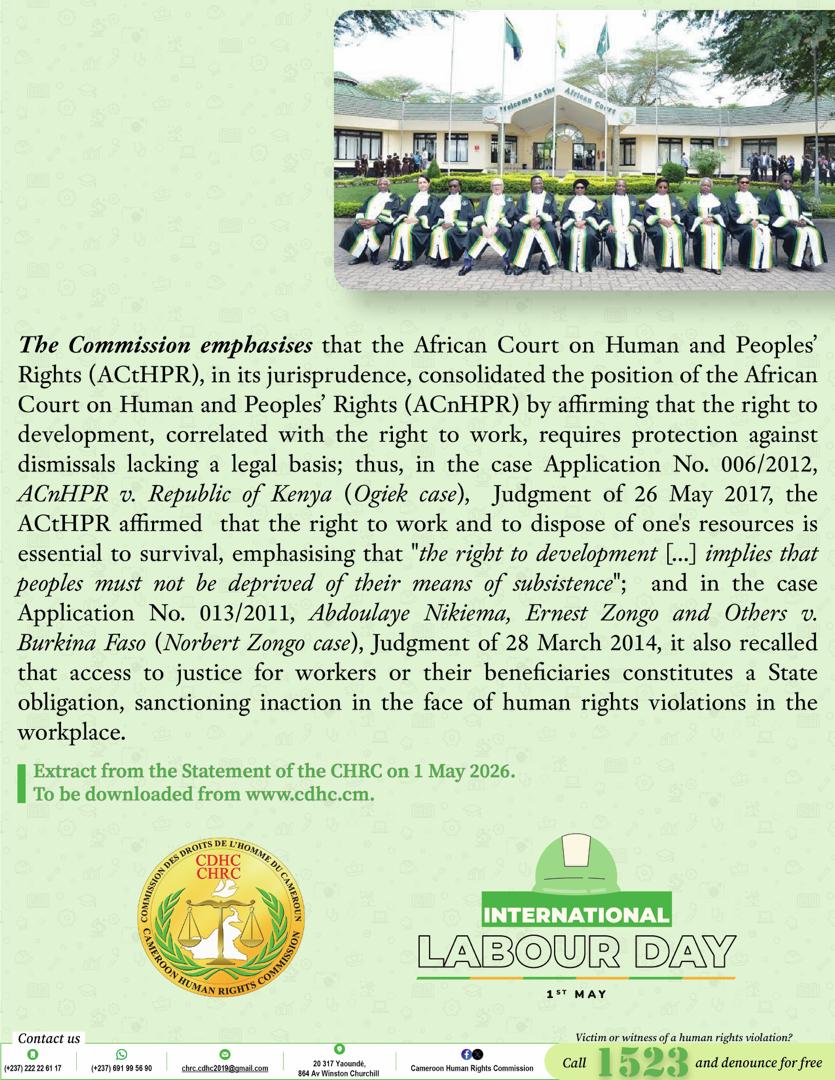
The Commission emphasises that the African Court on Human and Peoples’ Rights (ACtHPR), in its jurisprudence, consolidated the position of the African Court on Human and Peoples’ Rights (ACnHPR) by affirming that the right to development, correlated with the right to work, requires protection against dismissals lacking a legal basis ; thus, in the case Application No. 006/2012, ACnHPR v. Republic of Kenya (Ogiek case), Judgment of 26 May 2017, the ACtHPR affirmed that the right to work and to dispose of one’s resources is essential to survival, emphasising that « the right to development […] implies that peoples must not be deprived of their means of subsistence » ; and in the case Application No. 013/2011, Abdoulaye Nikiema, Ernest Zongo and Others v. Burkina Faso (Norbert Zongo case), Judgment of 28 March 2014, it also recalled that access to justice for workers or their beneficiaries constitutes a State obligation, sanctioning inaction in the face of human rights violations in the workplace.
The Commission also emphasises that, in a context marked by the need to guarantee a fair and stable working environment, it is imperative that public authorities, through the competent administrations — notably the Ministry of Labour and Social Security (MINTSS), the National Social Insurance Fund (NSIF) — as well as trade unions and the competent courts, strengthen the synergy and coordination of their actions with a view to promoting constructive social dialogue and guaranteeing decent work, which are essential factors for social peace, national cohesion and the sustainable development of enterprises in Cameroon.
The Commission is pleased to note Government’s efforts to mitigate the impact of cuts to US-funded health programmes, particularly through measures to support community health workers (CHWs), including salary, allowance and/or bonus payments, as well as establishing financing mechanisms to ensure the continuity of essential health services. Several structural actions have been undertaken in this regard, including :
The restructuring of community health system to reduce its dependence on external funding ;
The targeted redeployment of health personnel to address gaps created by the reduction in the number of CHWs ;
The signing, on 16 December 2025, of a Memorandum of Understanding with the Government of the United States of America, which provides for financial support estimated at approximately 24 billion CFA francs and
The progressive recruitment of 9,944 health workers over a five-year period to strengthen the resilience and performance of the national health system in the long term.
The Commission remains deeply concerned about the non-compliance by certain employers (particularly in the private sector) with Decree No. 2023/00338/PM of 21 March 2023 to fix the Guaranteed Inter-professional Minimum Wage (SMIG) in the public service at 60,000 francs CFA, which not only undermines fair labour practices, but also adversely affects a range of other rights, including :
The right to an adequate standard of living ;
The right to education of workers’ children ;
The right to health care ; and
The right to social security.
The Commission underscores that corruption constitutes a systemic impediment to the realisation of decent work and the consolidation of social dialogue in Cameroon ; that it manifests itself through illicit deductions from wages in certain enterprises, the monetisation of recruitment processes, or the falsification of social security records, thereby diverting resources essential to workers’ wellbeing.
The Commission considers that any attempt to workers’ right to sufficient and regular remuneration compromises social stability and weakens national cohesion ; the Commission therefore calls upon employers to recognise that reducing the purchasing power is a significant rise factor that can undermine security and weaken national social cohesion, while social dialogue must remain the primary preventive mechanism for cushioning inflationary shocks while safeguarding the sustainability of the enterprise.
The Commission notes that of the 220 recommendations accepted by the State following the adoption of the Report of Cameroon after undergoing the fourth cycle of the Universal Periodic Review (UPR) on 26 March 2024, seven are aligned with workers’ rights ; these recommendations are reproduced in today’s Statement and have been transmitted by the National Human Rights Institution to the relevant State bodies, development partners and the National Employment Fund (NEF), each as far as it is concerned.
The Commission specifically recommends that the Government should ensure that companies operating within the national territory comply effectively with substantive human rights standards ; this includes carrying out due diligence and establishing accessible, transparent and effective grievance mechanisms to benefit workers, local communities and neighbouring populations who believe their rights have been violated, prohibiting the exploitation of vulnerable groups, such as children, by companies, and promoting corporate social responsibility (CSR).
The Commission specifically recommends that the Ministry of Labour and Social Security (MINTSS) and workers’ trade unions should strengthen the regulation of recourse to temporary employment contracts and labour outsourcing to prevent precariousness from becoming the norm, while encouraging the conversion of unwarranted contracts into permanent contracts.
The Commission specifically recommends that employers in both the public and private sectors should institutionalise or strengthen permanent social dialogue to prevent conflicts, ensure a working environment free from harassment and discrimination and exercise due diligence to prevent, mitigate or remedy any adverse impacts on human rights.
The Commission specifically recommends that workers’ trade unions strengthen training for workers on their rights and obligations, including for more constructive participation in collective bargaining.
Source: CDHC


Leave a reply