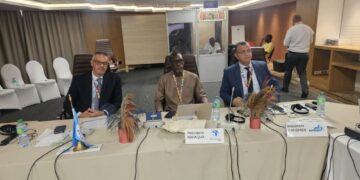
DÉCLARATION DE LA COMMISSION DES DROITS DE L’HOMME DU CAMEROUN À L’OCCASION DE LA JOURNÉE INTERNATIONALE DE L’ACCÈS UNIVERSEL À L’INFORMATION
STATEMENT BY THE CAMEROON HUMAN RIGHTS COMMISSION TO MARK THE INTERNATIONAL DAY FOR UNIVERSAL ACCESS TO INFORMATION
28 September 2026
Theme : Upholding Information Integrity in the Digital Age: The role of access to information in addressing information disorder
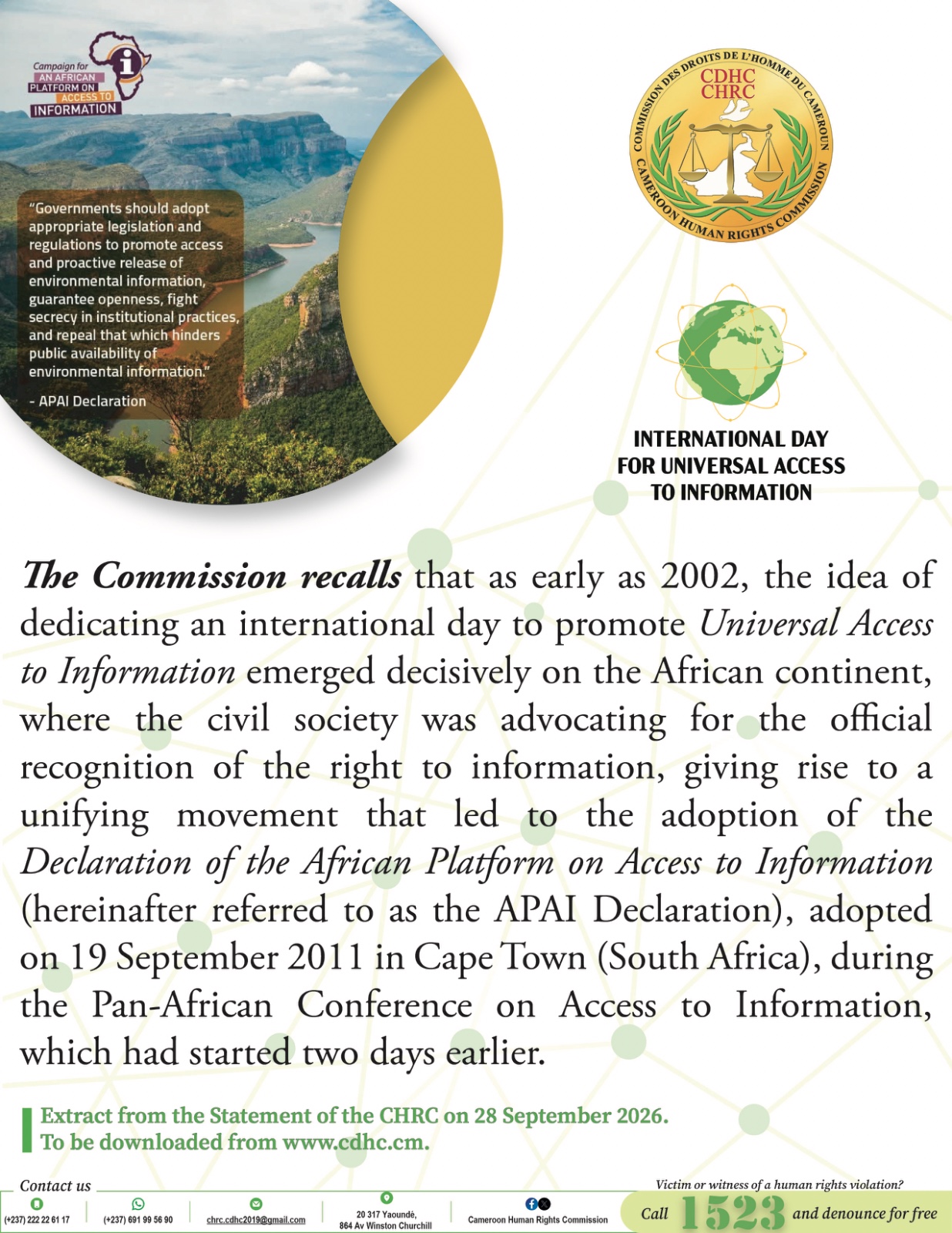
The Commission recalls that as early as 2002, the idea of dedicating an international day to promote _Universal Access to Information_ emerged decisively on the African continent, where the civil society was advocating for the official recognition of the right to information, giving rise to a unifying movement that led to the adoption of the _Declaration of the African Platform on Access to Information_ (hereinafter referred to as the APAI Declaration), adopted on 19 September 2011 in Cape Town (South Africa), during the Pan-African Conference on Access to Information, which had started two days earlier.
The Commission warmly welcomes the theme chosen by the United Nations Educational, Scientific and Cultural Organisation (UNESCO) for this 11th edition of the International Day for Universal Access to Information, namely, _Upholding Information Integrity in the Digital Age: The role of access to information in addressing information disorder,_ a theme which highlights the importance of timely and reliable access to information to prevent disinformation and other forms of information disorder in the digital age.
The Commission commends the efforts made by public authorities and their partners to promote access to reliable information and prevent the dissemination of false information, notably through the ongoing implementation of the _National Community Radio Expansion Programme_ , with the support of United Nations Educational, Scientific and Cultural Organisation (UNESCO), which provides for the establishment of 40 additional community radio stations by 2030 in addition to the 40 community radio stations already created and functional, to improve access to information in underserved areas and to all indigenous peoples through programmes broadcast in their native languages.
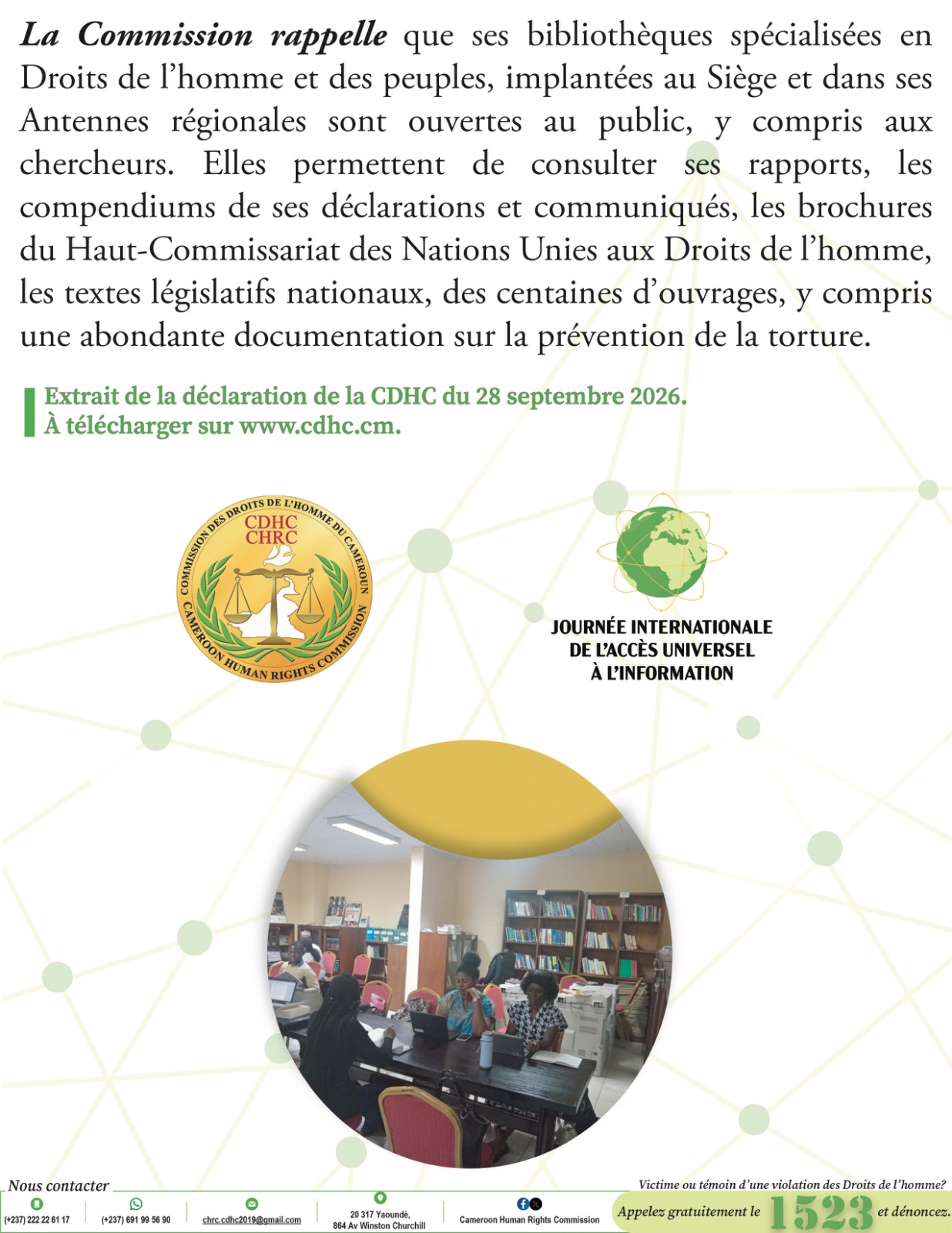
The Commission recalls that its specialised libraries on human and peoples’ rights, located at its Head Office and Regional Branches, are open to the public, including researchers. They provide access to the Commission’s reports, compendiums of its statements and press releases, publications of the Office of the United Nations High Commissioner for Human Rights, national legislation, hundreds of books, as well as extensive documentation on the prevention of torture.
Observations
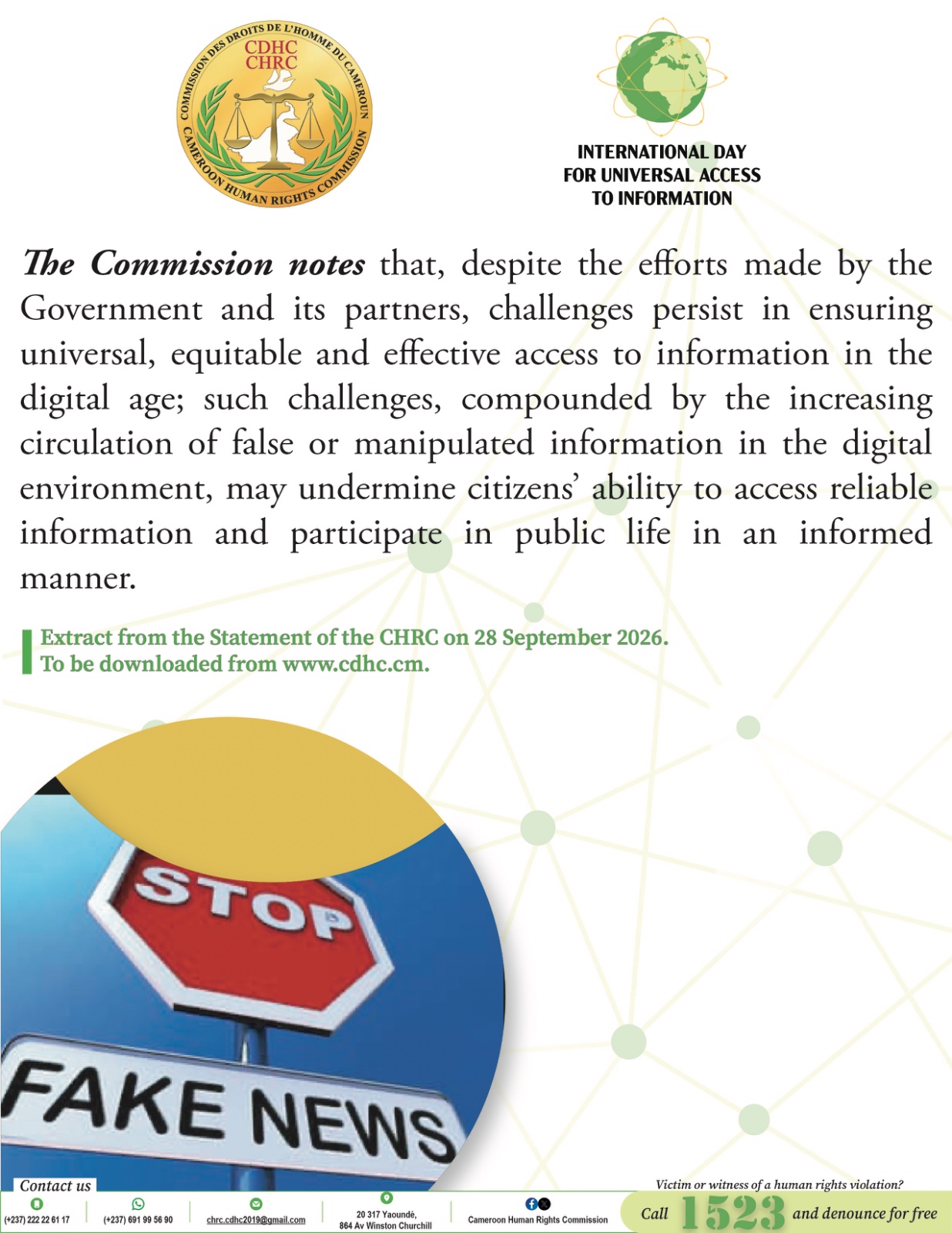
The Commission notes that, despite the efforts made by the Government and its partners, challenges persist in ensuring universal, equitable and effective access to information in the digital age; such challenges, compounded by the increasing circulation of false or manipulated information in the digital environment, may undermine citizens’ ability to access reliable information and participate in public life in an informed manner.
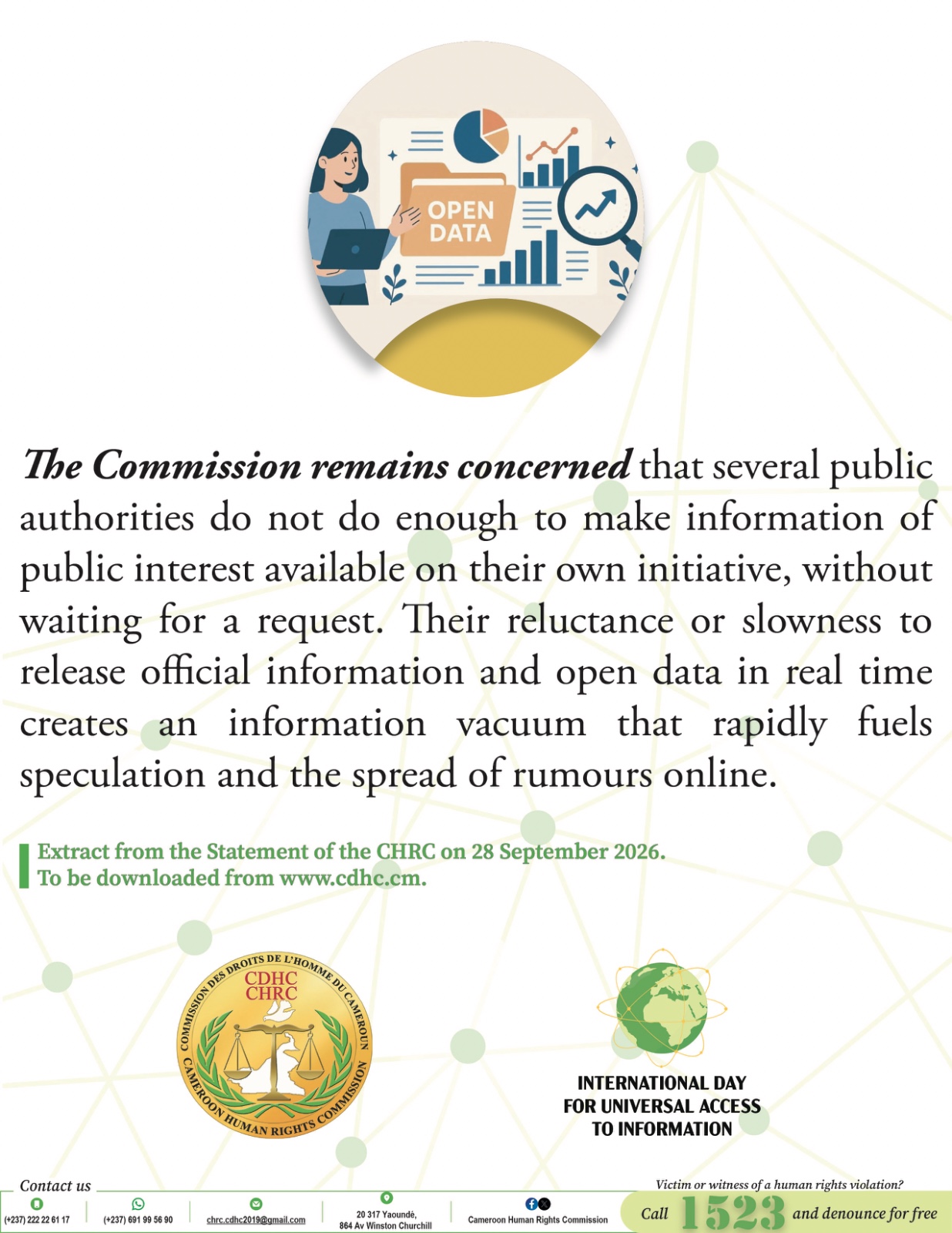
The Commission remains concerned about the persistent lack of proactive transparency within several public administrations, whose reluctance or delays in communicating official information and real-time open data create harmful information vacuum, which quickly fuels speculation and the spread of rumours online.
The Commission specifically recommends that the the Ministry of Communication (MINCOM) should continue the process of finalising the general legislative framework on universal access to information and submit the corresponding bill to Parliament, while ensuring that it provides for the publication of information of public interest, including the disclosure of official information without prior request, establishes clear procedures for accessing information, provides for strictly defined exceptions and guarantees effective redress.
The Commission notes that, of the 220 recommendations accepted by the State following the adoption of the _Report of Cameroon_ after undergoing the fourth Cycle of the Universal Periodic Review (UPR) on 26 March 2024, two are consistent with the theme of _International Day for Universal Access to Information_ ; they are reproduced in today’s statement by the Cameroon Human Rights Commission (CHRC), after being disseminated by the country’s National Human Rights Institution (NHRI) to the relevant State structures, each as far as it is concerned.
The Commission welcomes the actions taken by the competent authorities , each within the scope of its mandate, to regulate and develop the national digital space, including those of the Ministry of Posts and Telecommunications (MINPOSTEL), which actively promotes digital accessibility, as illustrated in 2026 by the organisation of the 5th Digital Innovation Week, at the end of which the InReach project, designed to make Internet and media content accessible to deaf and hard-of-hearing persons, received the Special Prize of the President of the Republic on 31 July 2026 in Yaounde.
DÉCLARATION DE LA COMMISSION DES DROITS DE L’HOMME DU CAMEROUN À L’OCCASION DE LA JOURNÉE INTERNATIONALE DE L’ACCÈS UNIVERSEL À L’INFORMATION
28 septembre 2026
Thème: Préserver l’intégrité de l’information à l’ère numérique : le rôle de l’accès à l’information face au désordre informationnel
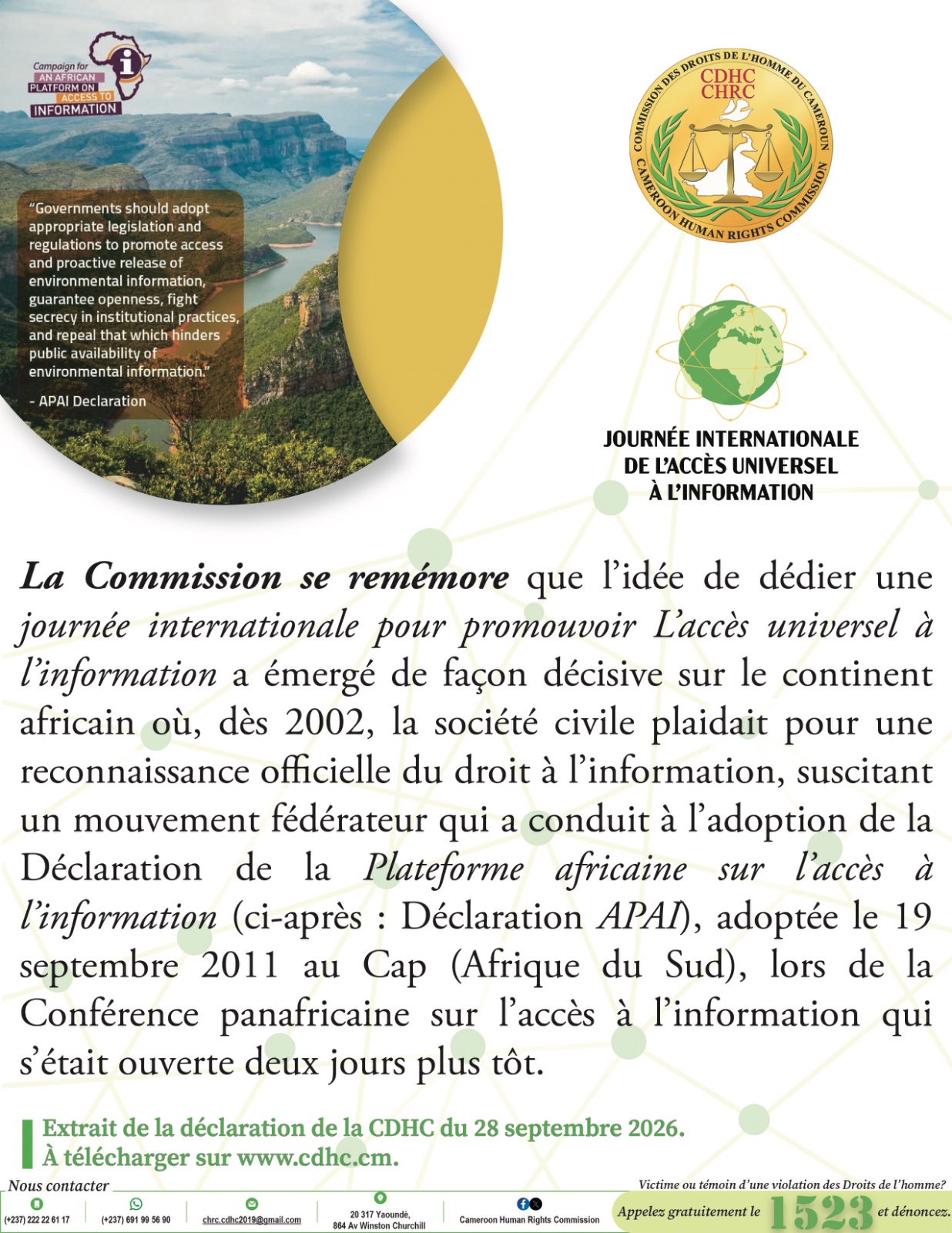
La Commission se remémore que l’idée de dédier une journée internationale pour promouvoir _L’accès universel à l’information_ a émergé de façon décisive sur le continent africain où, dès 2002, la société civile plaidait pour une reconnaissance officielle du droit à l’information, suscitant un mouvement fédérateur qui a conduit à l’adoption de la _Déclaration de la Plateforme africaine sur l’accès à l’information_ (ci-après : Déclaration APAI), adoptée le 19 septembre 2011 au Cap (Afrique du Sud), lors de la Conférence panafricaine sur l’accès à l’information qui s’était ouverte deux jours plus tôt.
La Commission accueille avec satisfaction le thème retenu par l’Organisation des Nations Unies pour l’éducation, la science et la culture (UNESCO) pour cette 11e édition de la Journée internationale de l’accès universel à l’information, à savoir _Préserver l’intégrité de l’information à l’ère numérique : le rôle de l’accès à l’information face au désordre informationnel,_ un thème qui met en évidence l’importance d’un accès rapide et fiable à l’information pour prévenir la désinformation et les autres formes de désordre informationnel à l’ère numérique.
La Commission salue les efforts des pouvoirs publics et de leurs partenaires visant à favoriser l’accès à une information fiable et à prévenir la diffusion de fausses informations, notamment à travers la poursuite du _Programme national d’extension des radios de proximité_ mis en œuvre avec l’appui de l’Organisation des Nations Unies pour l’éducation, la science et la culture (UNESCO), qui prévoit le déploiement de 40 nouvelles radios communautaires à l’horizon 2030, en plus des 40 radios communautaires déjà créées et opérationnelles, afin d’améliorer l’accès à l’information dans les zones insuffisamment desservies et à toutes les populations autochtones à travers des émissions en langue maternelle.
La Commission rappelle que ses bibliothèques spécialisées en Droits de l’homme et des peuples, implantées au Siège et dans ses Antennes régionales sont ouvertes au public, y compris aux chercheurs. Elles permettent de consulter ses rapports, les compendiums de ses déclarations et communiqués, les brochures du Haut-Commissariat des Nations Unies aux Droits de l’homme, les textes législatifs nationaux, des centaines d’ouvrages, y compris une abondante documentation sur la prévention de la torture.
Observations
La Commission constate qu’en dépit des efforts consentis par le Gouvernement et ses partenaires, des difficultés subsistent dans l’accès universel, équitable et effectif à l’information à l’ère numérique ; des difficultés qui, combinées à la circulation croissante d’informations fausses ou manipulées dans l’environnement numérique, peuvent affecter la capacité des citoyens à accéder à une information fiable et à participer de manière éclairée à la vie publique.
La Commission demeure préoccupée par les réticences ou les lenteurs persistantes de plusieurs administrations à diffuser sans demande préalable, des informations officielles d’intérêt public. Cela crée un vide informationnel qui alimente rapidement les spéculations et la propagation de rumeurs en ligne.
La Commission relève que, parmi les 220 recommandations acceptées par l’État lors de l’adoption du Rapport du passage du Cameroun au 4e cycle de l’Examen périodique universel (EPU) le 26 mars 2024, deux sont relatives au droit d’accès à l’information ; elles sont reproduites dans la Déclaration de la Commission des Droits de l’homme du Cameroun (CDHC) de ce jour, après avoir été ventilées par l’institution nationale des Droits de l’homme (INDH) du pays aux structures pertinentes de l’État, chacune en ce qui la concerne.
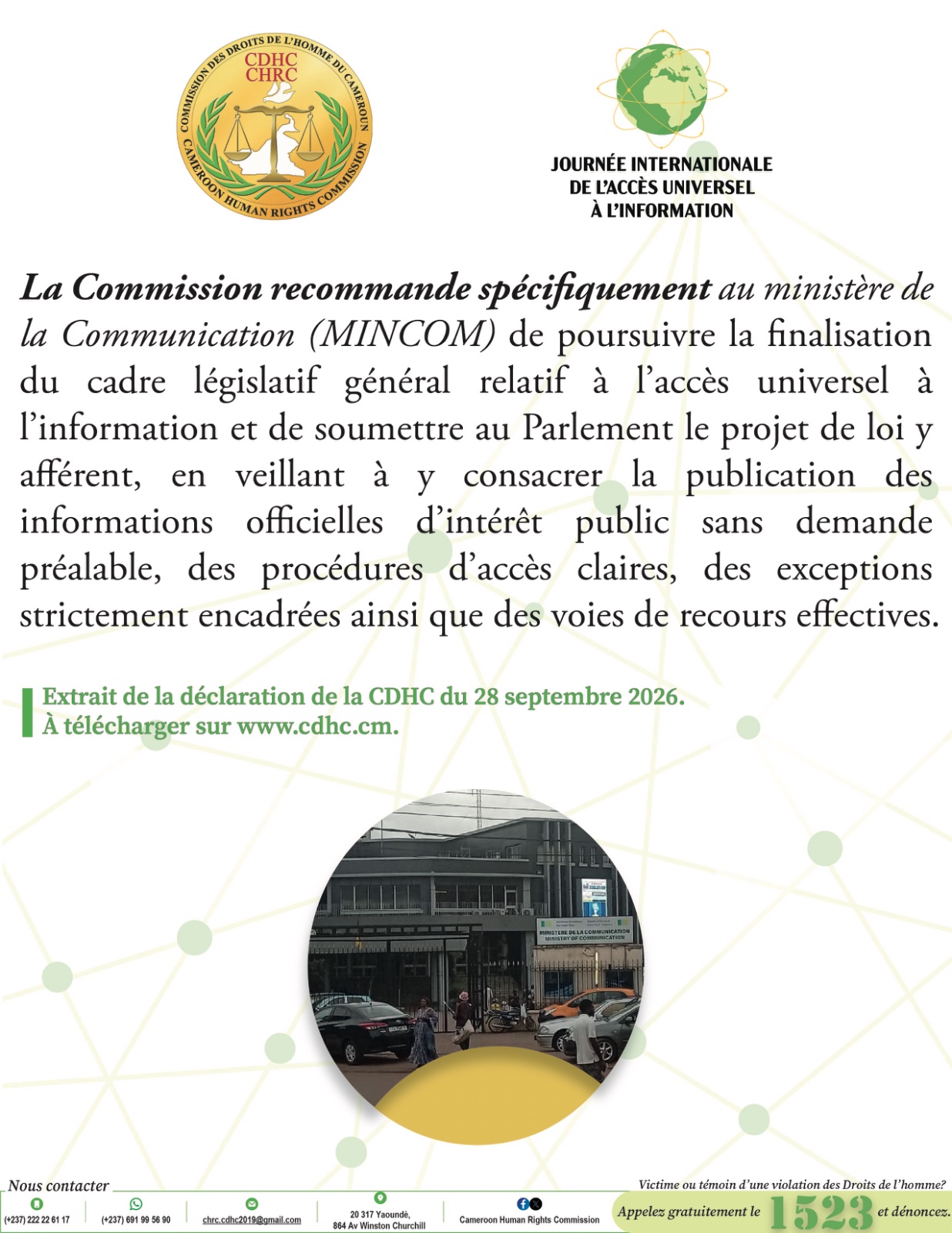
La Commission recommande spécifiquement au ministère de la Communication (MINCOM) de poursuivre la finalisation du cadre législatif général relatif à l’accès universel à l’information et de soumettre au Parlement le projet de loi y afférent, en veillant à y consacrer la publication des informations d’intérêt public, notamment la publication d’informations officielles sans demande préalable, des procédures d’accès claires, des exceptions strictement encadrées ainsi que des voies de recours effectives.
La Commission salue les actions des administrations compétentes qui œuvrent, chacune dans le cadre de ses attributions, à l’encadrement et au développement de l’espace numérique national, parmi lesquelles le ministère des Postes et Télécommunications (MINPOSTEL) qui promeut activement l’accessibilité numérique, illustrée en 2026 par l’organisation de la 5e Semaine de l’innovation numérique, à l’issue de laquelle le projet _InReach_ , destiné à rendre les contenus Internet et médias accessibles aux personnes sourdes et malentendantes, a reçu le _Prix spécial du Président de la République le 31 juillet 2026 à Yaoundé_ .
Source : Celcom CDHC



Leave a reply