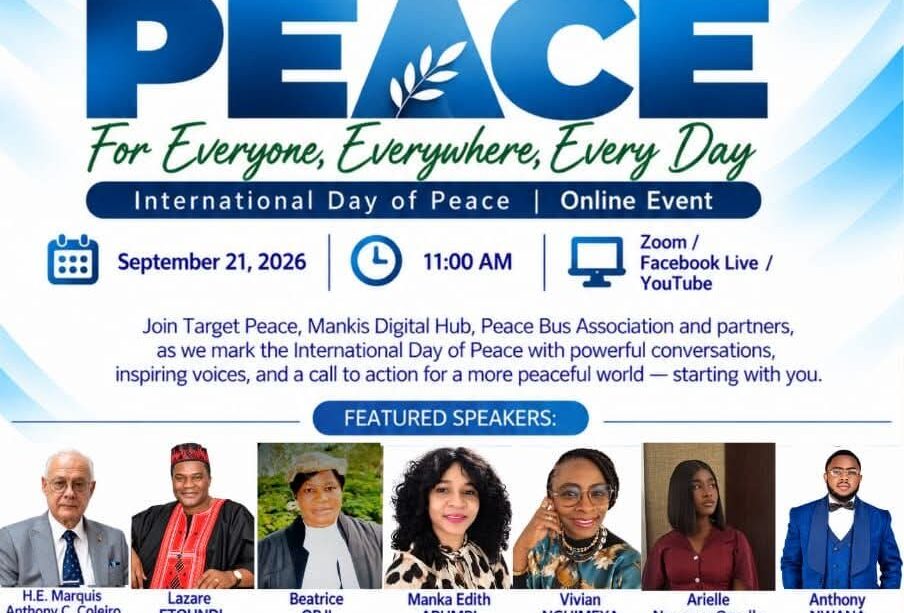
Amy Banda, who hosted and moderated the event, is a peacebuilding advocate, youth development leader, community organiser and communications professional known for facilitating conversations on peace, social justice, youth participation and community transformation.
Drawing on his experience in Cameroon’s North-West Region, Anthony Nwana noted that insecurity affects far more than physical safety. It can disrupt education, livelihoods, family life, opportunities and young people’s aspirations.
He stressed that peace must therefore be understood not only as the absence of violence but also as the presence of opportunity, dignity, participation and hope.
“We cannot always choose the circumstances in which young people grow up, but we can choose whether we give them the tools to rise above those circumstances.”
Anthony Nwana identified resilience, opportunity, youth participation and responsible communication as key areas requiring greater investment. He called for stronger support for education, skills development, entrepreneurship, technology, vocational training, creative industries and youth leadership.
He said young people need meaningful pathways through which they can contribute positively to their communities and help shape solutions to the challenges they face.
“Peace is not only the absence of violence; peace is also the presence of opportunity.”
He also highlighted the growing role of technology and social media in contemporary peacebuilding. While digital platforms can connect communities, expand access to information and promote learning, they can also amplify misinformation, rumours, fear and division.
He encouraged young people to practise responsible digital communication by thinking critically before sharing information and considering whether their words contribute to understanding or deepen division.
“Every time we post, share or comment, we are making an investment. The question is: what kind of world are we investing in?”
A central part of his message was the need to move beyond viewing young people merely as beneficiaries of peace initiatives. He called for their meaningful participation in decision-making, community programmes and the development of solutions that affect their lives and communities.
“Young people are not simply the future. They are already part of the present.”
He concluded by urging society to give young people not only responsibilities but also the education, opportunities and hope they need to build and sustain a peaceful future.
“Don’t just ask young people to protect peace. Give them something worth protecting.”
His contribution reinforced the broader message of the #InvestInPeace campaign: sustainable peace requires continuous investment in people, communities and, above all, the generation that will shape tomorrow.
Anthony Nwana M.
Communication & Peacebuilding Advocate | IT Professional
Speaking Angle: Investing in Young People: Building Resilience, Opportunity and a Culture of Peace
Closing Remarks
« As we close, let us remember that peace is not a distant dream reserved for leaders or institutions. It is a daily choice, made in our homes, our communities, our places of work and even in the words we speak.
To invest in peace is to invest in dignity, justice, dialogue and the future of our children. Let us not wait for the world to change before we act. Each of us has a role: to listen more deeply, reject violence, build bridges and stand for what is right.
May the conversations we have shared today move beyond this platform into practical action. Together, let us make peace everyone’s responsibility, everywhere, every day.
Thank you to Target Peace, Mankis Digital Hub, Peace Bus Association, the host, speakers and every participant. May peace begin with us and live through us.
Dr Esther NJOMO OMAM
President of Outreach Cameroon »

Leave a reply